

As Canada’s ongoing affordability crisis continues, housing access is top-of-mind for many throughout the nation.
The average home price in Canada has quadrupled in less than three decades and now the country is among the most expensive real estate markets in the world.
Experts posit that Canada must build several million new homes by 2030, but the country seems stuck behind pace.
“This isn’t just a housing shortage; it’s a systems-level crisis,” argues Noah Leduc, Senior Manager of Government Relations & Grants at Foresight Canada. “Addressing it requires coordinated action, bold innovation, and a shift in how we plan, build, and deliver housing.”
Leduc believes Foresight’s role is to help build national capacity to identify, scale, and adopt housing solutions that are faster, smarter, and more sustainable.
“We act as a bridge—between innovators and end-users, [between] policy and practice, [between] ambition and execution,” he explains.
Part of this bridge comes in the form of the “CMHC Housing Supply Challenge: Level-Up,” which focuses on unlocking system-level changes to “entrenched inefficiencies.”
These inefficiencies include things like improving skills gaps in workforce development in the real estate sector as well as making it easier to access financing for homeownership.
On the clean energy front, Foresight’s work promises to boost the sustainability of the building process and the buildings themselves by supporting innovation in the field, scaling promising technologies across “the full built environment value chain—from early-stage design to financing, permitting, and deployment,” according to Leduc.
The goal is to scale solutions that accelerate housing development in a tech-forward, eco-friendly fashion.
Foresight recently identified 18 such solutions through the CMHC Housing Supply Challenge.
One example is Toronto’s Promise Robotics, who is redefining sustainable homebuilding through advanced robotic automation and AI-optimized workflows.
The Canadian company’s platform streamlines the entire process from digital design to robotic production to on-site logistics, providing builders a tool to scale production, overcome labor constraints, and meet growing housing demand.
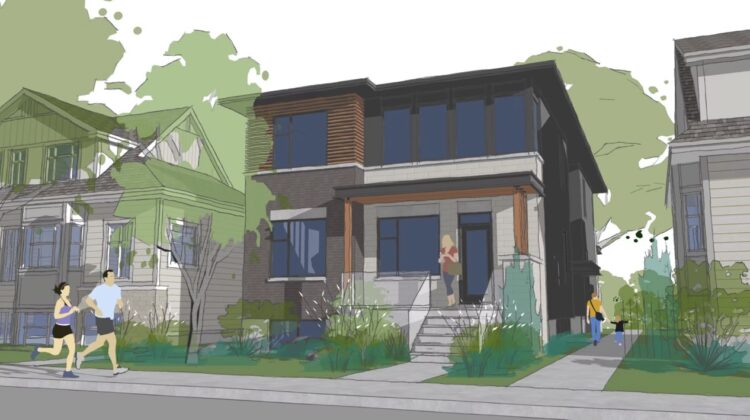
There’s also BuildingIN, which utilizes digital simulations and 3D modelling to help cities refresh aging blocks with low-rise infill development.
“Most Canadians want to live in walkable, tree-lined neighbourhoods with access to transit and essential services,” the company states. “Improving older neighbourhoods means understanding the interconnectedness of increasing housing supply, enhancing community vitality, reducing emissions, and balancing municipal budgets.”