

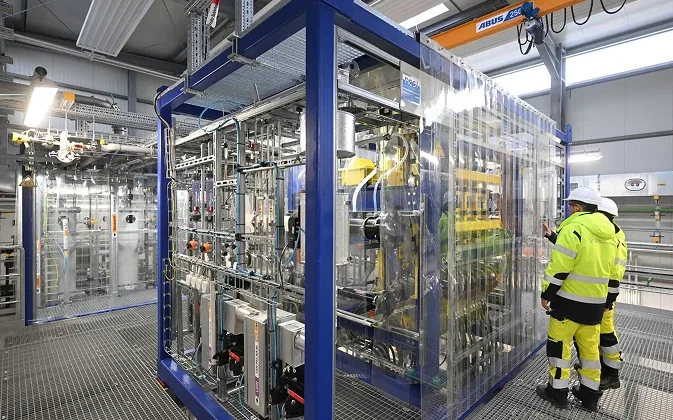
A Canadian clean technology company innovating industrial electrochemical processing has begun construction on a Lithium Plant in Germany.
Vancouver’s NORAM Electrolysis Systems, known as NESI, is working with Vulcan Energy Resources on the Central Lithium Plant at Infraserv Industrial Park Höchst in Frankfurt.
Vulcan is developing a major lithium and renewable energy project focused on producing battery materials locally while reducing reliance on imported supply.
The forthcoming facility is part of Vulcan’s Lionheart Project, which will use NORAM’s proprietary NORSCAND electrolysis technology to convert lithium chloride into battery-quality lithium hydroxide monohydrate, a critical material used in electric vehicle batteries.
“Commencing construction on our Central Lithium Plant is a defining moment for Vulcan and the European battery value chain,” commented Cris Moreno, CEO of Vulcan Energy.
The project is targeting a production capacity of 24,000 tonnes of LHM annually, enough for approximately 500,000 electric vehicle batteries per year.
For NORAM, the Lionheart Project represents a real-world deployment of its electrochemical platform in the global battery materials supply chain.
The groundbreaking ceremony was attended by Boris Rhein, Minister-President of the State of Hesse, and Mike Josef, Lord Mayor of Frankfurt am Main, among other stakeholders.
“This groundbreaking is a major validation of NESI’s role in scaling cleaner electrochemical infrastructure for battery materials,” stated Jeremy Moulson, chief executive officer of NORAM Electrolysis Systems, which is often branded as NESI.
“By integrating our NORSCAND technology into the Lionheart Project, we are helping advance a cleaner, electrified approach to lithium refining at commercial scale,” he said.
“This milestone strengthens the German-Canadian partnership and places NESI’s technology at the centre of Europe’s lithium and battery materials buildout,” Moulson stated.
“Our collaboration with NESI ensures our operations achieve the high-purity, low-impact outputs necessary to deliver the world’s first integrated sustainable lithium and renewable energy business,” remarked Moreno.
“We are proud to work alongside partners who share our vision for a decarbonized future,” he said.
Commercial production of the facility is targeted for 2028.