

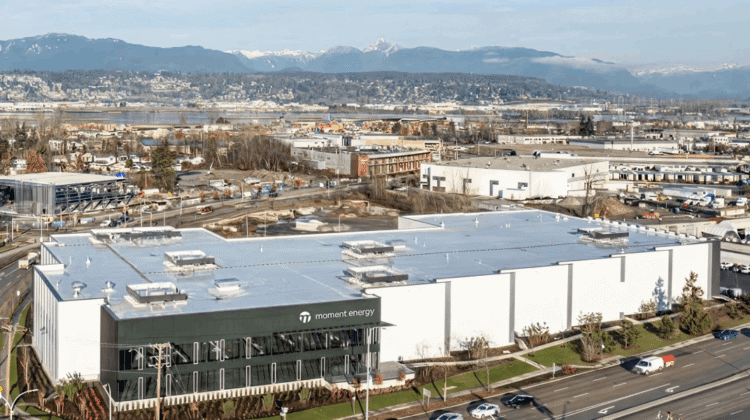
Moment Energy is building what it says will become the world’s largest battery repurposing facility in Surrey, B.C., marking a major step forward for Canada’s clean energy manufacturing sector.
The Vancouver-founded company announced that the new facility will be built over the next six weeks and is expected to be complete and fully operational by the end of June 2026.
Moment Energy Co-Founder and CEO Edward Chiang announced the news at Web Summit Vancouver, framing the project as a major move toward scaling domestic energy storage infrastructure at a time when demand for reliable power is rising across North America.
The announcement comes just weeks after Moment Energy closed a US$40 million Series B funding round, bringing total capital raised to more than US$100 million and underscoring growing investor confidence in the company’s role in the future of energy systems.
The new Surrey facility will expand Moment’s North American manufacturing footprint and accelerate the production of second-life battery energy storage systems for data centres, industrial customers, utilities, hospitals, factories, and microgrids.
“This is about building the infrastructure needed to support the next generation of energy demand,” said Chiang. “We are proud to establish this facility in Canada, the country where Moment Energy was founded, to foster domestic manufacturing. This scaling solution utilizes existing battery resources to deliver the reliable, affordable power that is so crucial right now.”
Moment Energy repurposes retired electric vehicle batteries into commercial-scale energy storage systems, extending the useful life of critical materials before batteries are eventually recycled.
At Web Summit Vancouver, Chiang described the model as a way to solve both an energy infrastructure challenge and a looming battery waste problem.
“Let’s not landfill batteries,” Chiang said. “Let’s actually keep these batteries that often have 80, 90, 95% of life left after 10 or 15 years in a vehicle, and then repackage them into stationary storage for another 15, 20 plus years, and deploy them on grid.”
The company says the approach offers a faster and more affordable way to deploy storage than traditional battery manufacturing, while reducing reliance on foreign battery supply chains.
Once complete, the Vancouver site is expected to become the largest certified, non-FEOC second-life battery facility in the world. Moment says the facility will reach 1 GWh of capacity by 2030 and create more than 100 skilled jobs.
The site will operate as a fully vertically integrated system, managing the full lifecycle from battery intake and testing through to integration and deployment. Moment says it will also be one of the only facilities globally operating under UL 1974 certification, a key safety standard for repurposing batteries.
The project comes as retired EV batteries are emerging as a major untapped clean energy resource. With hundreds of gigawatt-hours of batteries expected to come offline in the coming decade, second-life battery systems could play a growing role in meeting demand for energy storage while supporting critical mineral efficiency and domestic manufacturing.
Chiang said the company’s process also makes it easier to stand up local battery manufacturing because Moment is not building new battery cells from raw minerals. Instead, it tests existing battery modules and reassembles them into stationary storage systems.
Moment Energy partners with major automakers, including Mercedes-Benz Energy, to put retired EV batteries back to work before they are recycled.
With its new Vancouver facility, Moment Energy is positioning Canada at the centre of a growing second-life battery economy—one that connects clean energy storage, critical minerals, domestic manufacturing, and the rising power demands of the AI era.