

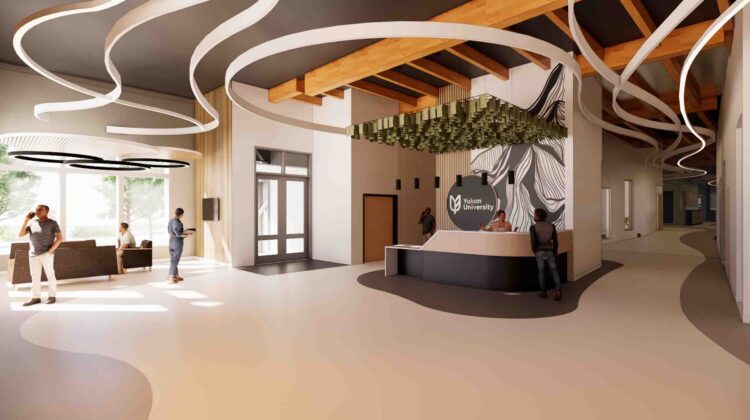
A project in the Yukon has become the first building in the Canadian Territories to be certified under the Zero Carbon Building Design Standard.
Yukon University’s Polaris Project achieved ZCB status from the Canada Green Building Council.
Inspired by the North Star, Polaris represents a vision “to create knowledge in new and transformative ways, to spark curiosity in future generations, and serve as a point of pride for Yukoners.”
Encompassing nearly 25,000 square feet, the new science building in Whitehorse features four classroom and multipurpose rooms, two wet and two dry research labs, a research and multi-use lab, and a social space for events.
The project team completed a lifecycle carbon analysis evaluating emissions associated with material production, transportation, replacement, and end-of-life processes over a standardized 60-year building life.
The facility is “designed for a northern climate and the demands of advanced research and teaching,” according to a statement, utilizing heat pumps alongside a heat recovery system that captures waste heat from the campus energy plant to reduce operational carbon.
The building was designed and engineered by Stantec, an architecture and environmental consulting firm based in Edmonton.
The project is targeting net-zero operations, with projected annual savings of 14,100 kilograms of carbon dioxide in emissions.
The building design aims to reduce site energy use intensity by more than 60% percent, according to a statement.
Yukon University traces its history to 1963, when the Whitehorse Vocational and Technical Training Centre opened on the banks of the Yukon River in downtown Whitehorse. College status was granted in the spring of 1983, and in 1988 the Whitehorse campus moved from downtown to its current location up the hill. In 2020, Yukon College was granted university status.
Founded in 1954, Stantec today trades on the TSX and the NYSE under the symbol STN.