
Artificial intelligence is creating an electricity demand challenge unlike anything the energy industry has encountered before — one that could require North America to add the equivalent of Canada’s entire power system twice over in just five years.
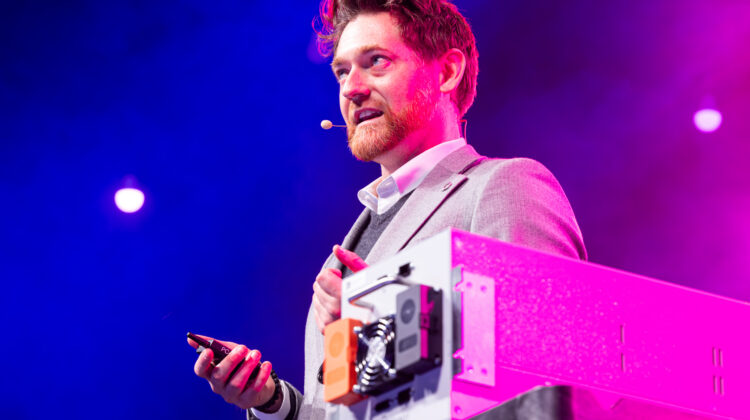
That was the scale of the challenge laid out by Aaron Foyer, Director of Research at Orennia, during the Energy Disruptors: UNITE 2026 conference held in Calgary.
Orennia forecasts approximately 1,100 terawatt-hours of new electricity demand from data centres between 2025 and 2030 across its North American outlook.
Canada currently generates roughly 550 terawatt-hours annually.
“So it’s kind of like in the next five years, we need to build two Canadas in five years,” Foyer told the audience. “It’s crazy, the scale of this growth.”
The spending behind that growth is equally striking. Foyer said Amazon, Alphabet, Microsoft, Meta and Oracle spent approximately $180 billion in the most recent quarter — around eight dollars for every dollar spent by the five major global oil and gas companies he compared them against.
The AI and data centre boom is also becoming an increasingly important part of Orennia’s business. CleanEnergy.ca previously reported that the Calgary-based energy intelligence company raised Series C growth financing led by Decarbonization Partners, a joint venture between BlackRock and Temasek. Orennia’s AI-powered Ion_AI platform provides data and analytics across power, renewables, clean fuels, and carbon capture, with the company using the financing to expand its capabilities into growing markets including data centres.
No Single Power Source Can Fill the Gap
The obvious question is where all that electricity will come from.
Nuclear will play a role, but Foyer said new projects — particularly small modular reactors — are unlikely to contribute meaningfully until the 2030s.
Natural gas is better positioned for immediate growth.
“Gas power is certainly going to be one of the big winners of this,” he said.
But gas has its own bottleneck: turbines.
Only three major companies manufacture the large industrial gas turbines required for new generation, and the complexity of producing them limits how quickly new plants can be added.
“There is an upper limit on how much gas we can add in the short term,” Foyer said.
Geothermal faces a similar timing issue, leaving a large gap between projected data-centre demand and the electricity conventional sources can add before 2030.
Wind, Solar — and a Lot More Batteries
Foyer believes much of that gap will have to be filled by wind and solar.
Across Canada and the United States, he said approximately 83 per cent of new generating capacity being added this year will come from those two sources.
“There’s only one thing that can possibly meet this demand,” Foyer said. “And that’s wind and solar.”
The challenge is reliability.
Even strong wind projects may generate electricity only around 45 per cent of the time, while solar projects can be closer to 35 per cent. Data centres, by contrast, require electricity virtually continuously.
That makes energy storage increasingly important.
Foyer said wind, solar and battery storage combined will account for about 90 per cent of new capacity being added across Canada and the United States this year.
He pointed to California as an example of batteries increasingly absorbing surplus solar electricity during the day and returning that power to the grid after sunset.
The technology is also evolving rapidly. During his presentation, Foyer displayed a battery cell assembled in Calgary as an example of the innovation occurring alongside the broader storage boom.
Despite widespread concerns about whether electricity systems can keep pace with AI, Foyer ended on an optimistic note.
“There’s a lot of anxieties right now about AI and data centers,” he said. “But we are going to solve this.”
The question is no longer whether AI will dramatically increase electricity demand. It is how quickly energy developers, utilities, and technology companies can assemble the mix of generation and storage required to meet it.