

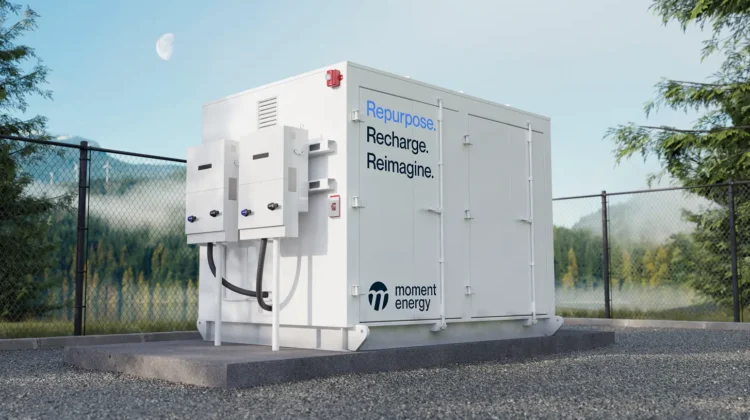
Two Canadian clean energy innovators announced recently that they are working together.
Vancouver-based battery repurposing innovator Moment Energy is collaborating with Toronto’s Pulsenics, a developer of electrochemical diagnostic equipment for the battery industry, on a joint project to develop advanced quality control for end-of-life EV batteries.
The initiative, supported by $5 million from Next Generation Manufacturing Canada, will aim to develop industrial-scale workflows based on AccelaGrade, a battery qualification solution launched by Pulsenics earlier this year.
The proprietary technology from the Ontario cleantech firm analyzes cell state of health 19 times faster than traditional cyclers, marking a step forward in scaling battery refurbishment.
“The ability to rapidly and accurately qualify used batteries is critical in scaling the second-life industry,” explains Edward Chiang, cofounder and CEO of Moment Energy.
The partnership “allows us to vastly increase our manufacturing capacity by several GWh,” says Chiang, who was in December named Fasken’s 2025 Climate Tech Founder of the Year.
“This growth is supported by our world-class battery testing methodology, which remains the safest in the industry as the only one to hold full UL certifications for years,” the entrepreneur stated.
Automakers and consumers “want to know they are working with a battery manufacturer that is unrelenting on safety and is always looking to keep the customer, community, and their employees safe,” Chiang believes.
Mariam Awara, a cofounder of Pulsenics, sees an “enormous opportunity” to keep batteries in the field as long as possible.
“As the first wave of electric vehicles reaches end-of-life … Moment Energy leads the field of battery repurposing into stationary battery storage and is the only UL-certified re-purposer in North America,” Awara stated. “We’re proud to help the BESS industry save money, reduce waste, and deploy used batteries faster.”
Since launching in 2019, Moment Energy has secured more than $60 million in combined equity and debt financing—including a Series A round co-led by the Amazon Climate Pledge Fund and Voyager Ventures, with participation from TD Innovation Partners—to scale production of its second-life battery technology.
The firm, which is innovating clean compute for SFU, was recognized as a Scale-up Venture of the Year finalist for the inaugural Canadian Cleantech Awards.
Founded in 2017, Pulsenics is currently working on the National Research Council of Canada’s Critical Battery Materials Initiative.